
AI and SEO: How Search Engines Are Changing in 2026
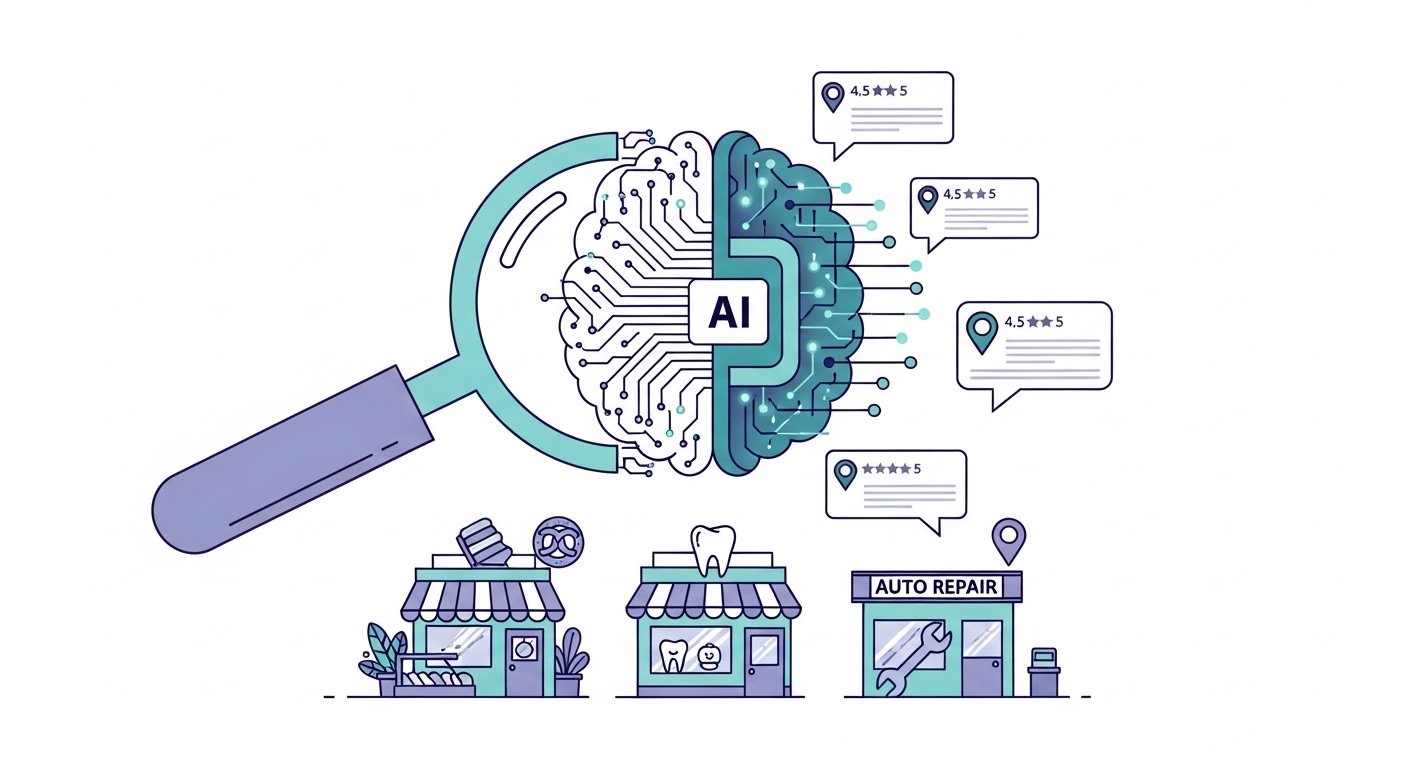
Your Customers Are Searching Differently. Here's What That Means for You.
If you run a local business, you've probably noticed something strange happening with your website traffic. Maybe your numbers are flat. Maybe they're dropping, even though your Google reviews are solid and your website looks fine. You're not imagining things.
AI and SEO are going through the biggest shift since Google became the default way people find businesses. Nearly 60% of all Google searches now end without anyone clicking a single link, according to research from Bain & Company. That number is climbing toward 70%.
The reason? Google, ChatGPT, Perplexity, and other search tools are answering questions directly. Instead of showing you ten blue links, they're giving you a summary right at the top of the page. For local businesses, this changes the game. But it's not all bad news, and it doesn't mean SEO is dead. It means the rules are evolving.
What AI Search Actually Looks Like Right Now
Picture this: a homeowner in Phoenix types "best plumber near me for a leaky faucet" into Google. Instead of a list of websites, they see an AI-generated summary at the top. It names two or three plumbers, pulls in their ratings, mentions their specialties, and even summarizes recent reviews. The homeowner calls one of those businesses without ever visiting a website.
That AI summary is called an "AI Overview," and it's appearing on roughly 25% of Google searches as of early 2026, according to Semrush's analysis of 10 million keywords. When these summaries show up, only 8% of users click on traditional results, compared to 15% when there's no AI summary. That's a 46.7% drop in clicks, confirmed by Seer Interactive's 2025 study.
And it's not just Google. ChatGPT now has over 700 million weekly users, and many of them are using it to find local services. Perplexity AI is growing fast too. These tools pull information from across the web, summarize it, and present it as a direct answer. If your business isn't structured in a way these tools can understand, you're invisible to a growing chunk of your potential customers.
The Numbers Every Local Business Owner Should Know
Here's a quick snapshot of where things stand:
60% of Google searches now end with zero clicks to any website (Bain & Company)
AI search traffic grew 527% year-over-year between January and May 2025 (Semrush)
AI referral traffic to small business websites jumped 123% in recent months (HubSpot)
89% of B2B buyers now use generative AI during purchasing decisions (Search Engine Journal)
Brands cited in AI Overviews earn 35% more organic clicks than those that aren't (Position Digital)
That last stat is the one to pay attention to. Yes, fewer people are clicking overall. But the businesses that AI chooses to mention? They're getting a bigger share of the clicks that do happen. The goal has shifted from "rank on page one" to "be the business AI recommends."
Why This Matters More for Local Businesses Than Big Brands
If you're a dentist in Austin or a roofing contractor in Charlotte, this shift hits differently than it does for Amazon or WebMD. Big brands have entire SEO teams. You have a website you built three years ago and a Google Business Profile you update when you remember.
The good news? Local businesses actually have some built-in advantages in AI search. AI tools like Google's AI Overviews and ChatGPT rely heavily on Google Business Profiles, review sites, and local directories to answer location-based questions. If you're a real business with real reviews serving a real community, you already have the raw material AI needs.
The bad news? If that information is outdated, inconsistent, or hard for machines to read, AI will skip right over you and recommend your competitor instead. A study from Audience Science found that businesses with inconsistent directory listings risk being excluded from AI recommendations entirely.
Seven Things You Can Do This Month to Show Up in AI Search
You don't need to overhaul your entire marketing strategy. Most of what works for AI search is good SEO practice that's been true for years, just with a few new twists. Here's what to prioritize:
1. Treat Your Google Business Profile Like Your Homepage
Google's AI Overviews pull local business data directly from Google Business Profiles. ChatGPT has started pulling from Google Maps too. This makes your GBP one of the most important pages you control.
Update your hours, services, business description, and photos. Make sure your business categories are accurate. Respond to reviews. A complete, active GBP is the single fastest way to improve your visibility in AI search results.
2. Make Your NAP Information Consistent Everywhere
NAP stands for Name, Address, Phone Number. AI tools cross-reference this information across dozens of sources. If your phone number on Yelp doesn't match your website, or your address on Google doesn't match your Facebook page, AI loses confidence in your data and may not include you in results.
Do a quick audit. Check Google, Yelp, Facebook, Apple Maps, and any industry-specific directories. Make sure everything matches exactly.
3. Add Structured Data (Schema Markup) to Your Website
This is the most technical item on the list, but it's also one of the most impactful. Schema markup is code added to your website that tells search engines and AI exactly what your business is, where you're located, what services you offer, and what your customers think of you.
Pages with comprehensive schema markup get a 36% advantage in AI-generated citations. At minimum, your website should have LocalBusiness schema, Service schema, and FAQ schema. If you're not sure what that means, ask your web developer or run a free SEO audit to see what's missing.
4. Answer Questions Your Customers Actually Ask
AI search tools are trained to match questions with direct answers. If someone asks "how much does a roof replacement cost in Denver," the AI is looking for a page that answers that exact question clearly and specifically.
Create an FAQ page (or add FAQ sections to your service pages) that addresses the real questions your customers ask. Use the question as a heading and put a direct, clear answer right below it. Pages with Q&A formatting are 40% more likely to be cited by AI engines.
5. Keep Your Content Fresh and Specific
Content updated within the last 30 days gets cited by AI tools 3x more often than older content. You don't need to publish blog posts every week. But updating your service pages with current pricing, new project photos, or seasonal information signals to AI that your business is active and your information is reliable.
Be specific to your location. Instead of "we offer HVAC services," try "we provide furnace repair and AC installation for homes in the greater Nashville area." That geographic specificity helps AI match you to local searches.
6. Build Your Reputation Across Multiple Platforms
AI tools don't just look at your website. They pull from reviews, social media mentions, news articles, and industry directories. The more places your business shows up with positive, consistent information, the more likely AI is to trust and recommend you.
Focus on getting reviews on Google, Yelp, and one or two industry-specific platforms. If you're a contractor, that might be Angi or Houzz. If you're a restaurant, it's TripAdvisor or OpenTable. Each mention builds what SEO professionals call "entity authority," and it's becoming the currency of AI search.
7. Make Sure Your Website Loads Fast
Pages that load in under two seconds are cited by AI up to 40% more often. AI tools crawl millions of pages and they favor ones that respond quickly. A slow website doesn't just frustrate your visitors. It tells AI systems that your site may not be reliable enough to cite.
Test your site speed at Google's PageSpeed Insights. If your score is below 50 on mobile, it's worth fixing. Compress your images, reduce unnecessary plugins, and talk to your hosting provider about performance.
What "SEO" Even Means Now
The industry is starting to use a new term: Generative Engine Optimization, or GEO. It's a fancy way of saying "optimize your online presence so AI tools recommend you." But here's the thing most articles about GEO won't tell you: if you're already doing SEO well, you're 80% of the way there.
GEO isn't a complete overhaul. It's an evolution. The foundations are the same: quality content, accurate business information, a fast website, and a good reputation. What's new is making sure that information is structured in a way machines can read, not just humans.
Think of it this way. Traditional SEO was like putting a well-designed sign on your storefront. GEO is making sure that sign is also readable by the robot that's now driving customers around town and recommending where to stop.
Don't Panic, But Don't Ignore This Either
Over 80% of users are somewhat skeptical of AI-generated answers. Only 9% say they always trust them. People still click through to websites. They still read reviews. They still want to talk to a real human before hiring someone to fix their roof or straighten their teeth.
But the way they find that real human is changing. AI is becoming the first filter, and if your business doesn't make it through that filter, fewer people will ever see your website, your reviews, or your phone number.
The businesses that adapt early will have a real advantage. Not because AI search is replacing everything overnight, but because most of your competitors haven't started thinking about this yet. While they're still focused on ranking for keywords, you can be building the kind of online presence that AI actually wants to recommend.
See Where Your Business Stands
Not sure how your website stacks up in this new AI-driven search environment? A comprehensive SEO audit can show you exactly what's working, what's missing, and what to fix first. Search & Rescue offers free SEO audits that cover everything from schema markup to site speed to content structure, all the factors AI search tools look at when deciding which businesses to recommend.
The search landscape is shifting. The question isn't whether to adapt. It's how soon you start.
Related Articles
SEO Audit Metrics Explained: What We Measure and Why
Not sure what all those SEO audit metrics actually mean? Here's a plain-English breakdown of the 7 scoring categories, 50+ checks, and severity ratings we use in every Search & Rescue audit report.
What Is an SEO Audit? A Guide for Local Businesses
An SEO audit is a checkup for your website that shows exactly why customers can't find you on Google. This guide breaks down every part of an SEO audit so local business owners know what to expect, what matters most, and how to act on the results.
HVAC SEO: A Complete Marketing Guide for HVAC Companies
HVAC SEO can generate 150 to 500 leads per month when done right. This complete guide covers everything HVAC companies need to rank higher on Google, win the local pack, and turn searches into booked jobs.
Get Your Free SEO Audit
Find out how your website scores across 7 SEO categories. Free, no strings attached.
Request Your Free Score