
HVAC SEO: A Complete Marketing Guide for HVAC Companies
HVAC SEO Is the Highest-ROI Marketing Channel You're Probably Ignoring
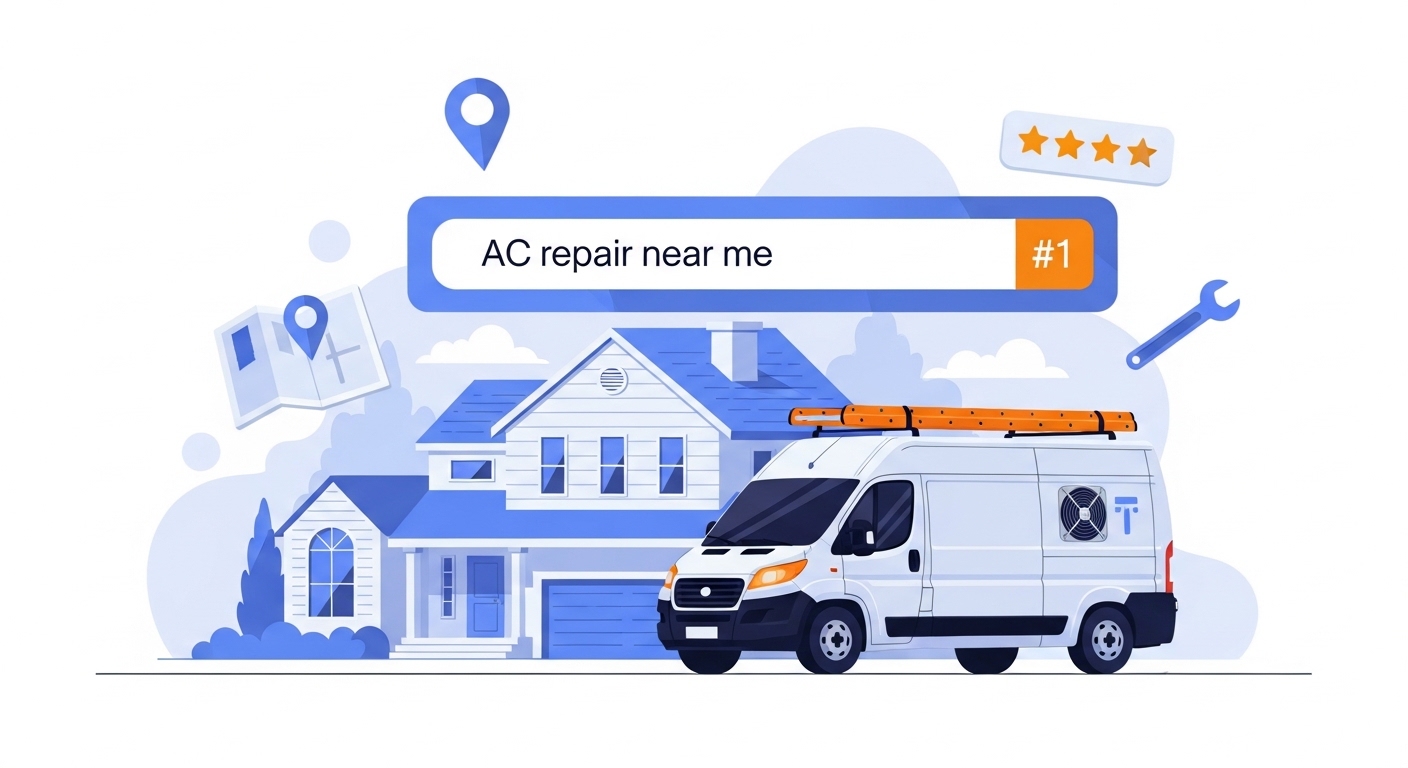
Your next customer is searching for you right now. They're typing "AC repair near me" into Google while sweat drips down their forehead. The question is: will they find your company, or your competitor's?
HVAC SEO is the process of optimizing your website and online presence so your company shows up when local homeowners search for heating and cooling services. And the numbers behind it are staggering. A Q4 2025 analysis of roughly 1,000 home-services companies found that the median ROI on SEO was 27.46x (Searchlight Digital). That means for every $1 spent on SEO, the typical HVAC company earned $27 back in closed revenue.
Yet most HVAC companies still rely almost entirely on word-of-mouth or expensive pay-per-click ads. This guide will walk you through every piece of HVAC SEO, from your Google Business Profile to your website's technical health, so you can start generating consistent leads without paying per click.
Why HVAC Companies Need SEO in 2026
Consider how your customers actually find you. 97% of people learn about a local company online before anywhere else (WebFX). And 84% of HVAC customers say they did not have a particular company in mind when they started searching. That means nearly every job is up for grabs in the search results.
Here's what makes this even more urgent: 75% of searchers never scroll past the first page of Google. If your HVAC company isn't ranking on page one, you're invisible to three out of four potential customers.
The HVAC industry in the U.S. is worth over $156 billion as of 2025 (Leads4Build). With that much money flowing through the market, even a small improvement in your search visibility can mean tens of thousands of dollars in new revenue each year.
Google Business Profile: Your Most Important Free Tool
If you only do one thing from this guide, make it this: claim and fully optimize your Google Business Profile (GBP). Google's Local 3-Pack appears at the top of 93% of local searches, and GBP drives roughly 52% of all organic revenue for HVAC companies (Searchlight Digital).
Here's what a fully optimized profile looks like:
Verify your listing. Without verification, Google will not show you in local results. Period.
NAP consistency. Your Name, Address, and Phone number must be identical across your website, GBP, Yelp, HomeAdvisor, and every other directory. Google rewards businesses with consistent information.
Choose the right categories. Categories create ranking eligibility. Select "HVAC Contractor" as your primary category, then add specific secondary categories like "Air Conditioning Repair Service" or "Furnace Repair Service."
Add photos regularly. Upload photos of your team, trucks, and completed jobs. Listings with quality photos get more clicks.
Post updates weekly. Google Business posts signal activity to both Google and potential customers. Share seasonal tips, promotions, or completed projects.
Reviews: The Ranking Factor You Can Control
81% of people rely on Google Reviews when choosing an HVAC company. Reviews also directly influence your local search rankings. Google looks at three things: how many reviews you have, how recent they are, and what keywords they contain.
The HVAC companies that dominate local search typically have 100+ reviews with an average rating above 4.5 stars. Here's how to build that review profile:
Ask at the right moment. The best time to ask is immediately after completing a job, when the customer is relieved and grateful. Train your techs to ask in person, then follow up with a text or email containing a direct link to your Google review page.
Make it easy. Create a short link (you can generate one from your GBP dashboard) and include it in your follow-up texts and emails.
Respond to every review. Thank positive reviewers by name and address negative reviews professionally. Google notices engagement, and so do future customers reading your reviews.
One more thing: 78% of leads go with the HVAC business that answers the phone first. Reviews get people to call you, but your intake process closes the deal.
Keyword Strategy: What Your Customers Are Actually Searching
HVAC SEO starts with understanding what words people type into Google. These fall into three categories:
Emergency/transactional keywords are what people search when something breaks. "AC repair near me," "emergency furnace repair," "no heat in house." These convert at the highest rate because the searcher needs help now.
Commercial keywords are what people search when they're comparing options. "Best HVAC company in [city]," "furnace replacement cost," "how much does a new AC unit cost." These searchers are close to buying but still shopping around.
Informational keywords are what people search when they have questions. "Why is my AC blowing warm air," "how often to change furnace filter," "what SEER rating do I need." These searchers aren't ready to buy today, but you can earn their trust with helpful content.
The sweet spot for most HVAC companies is a mix of all three. Your service pages should target transactional and commercial keywords. Your blog should target informational keywords that bring people into your world before their system breaks down.
Pro tip: long-tail keywords like "cost to replace a 3-ton AC unit in Phoenix" have lower search volume but much higher conversion rates. A page targeting that specific query could bring in 20 highly qualified clicks that are worth more than 500 visits from "HVAC tips."
Service Pages: One Page Per Service, Per City
This is where many HVAC companies leave money on the table. Instead of one generic "Services" page, you need a dedicated page for each core service you offer:
AC Repair
AC Installation
Furnace Repair
Furnace Installation
Heat Pump Services
Duct Cleaning
Maintenance Plans
Emergency HVAC Service
Each page should include the target keyword in the title tag, a clear description of the service, pricing guidance (70% of homeowners prefer contractors who post pricing), your service area, and a strong call-to-action with your phone number.
If you serve multiple cities, create location-specific versions of your most important service pages. A page titled "AC Repair in Scottsdale, AZ" will outrank a generic "AC Repair" page for searches in Scottsdale nearly every time. Just keep these pages under 25 within a 25-mile radius to avoid thin content penalties.
Technical SEO: The Foundation Under Everything
Technical SEO is the behind-the-scenes work that makes sure Google can find, read, and trust your website. You don't need to understand the code yourself, but you need to make sure these boxes are checked:
Page speed. Google research shows that 53% of mobile users leave a site if it takes longer than 3 seconds to load. Compress your images, minimize unnecessary code, and enable browser caching. Tools like Google PageSpeed Insights will tell you exactly what to fix.
Mobile-friendliness. Nearly 70% of HVAC searches happen on mobile devices. Google ranks your site based on its mobile performance, not desktop. If your site is hard to use on a phone, you're losing both rankings and customers.
HTTPS security. Your site needs an SSL certificate. Most hosting providers offer these for free. Without one, Google will show a "Not Secure" warning to visitors, which kills trust instantly for a business asking people to let strangers into their homes.
Schema markup. This is code that helps Google understand your business details. Local Business schema tells Google your address, hours, and services. Review schema can display your star rating directly in search results. If you're working with a web developer or SEO provider, ask them to implement it.
XML sitemap. Think of this as a map of your website that you hand to Google. Submit it through Google Search Console so Google can find and index all your pages efficiently.
Not sure where your site stands on the technical side? Search & Rescue offers a free SEO audit that checks all of these factors and tells you exactly what needs fixing.
Content Marketing: Become the Expert in Your Market
Blogging might feel like the last thing an HVAC company needs to worry about. But here's why it works: every blog post is another chance to show up in Google for a question your customers are asking.
A plumber in Denver wrote a blog post about "Why is my furnace making a banging noise?" That single page now brings in dozens of visitors each month, and some of those visitors become paying customers when they realize the fix isn't a DIY job.
Here are content ideas that consistently perform well for HVAC companies:
"How much does [service] cost in [city]?" (pricing guides)
"[Brand] vs. [Brand]: Which AC unit is better?" (comparison posts)
Seasonal maintenance checklists
"Signs you need a new [furnace/AC unit]" (buying guides)
"How to lower your energy bill in [season]" (money-saving tips)
Local rebate and incentive roundups
Each post should link to your relevant service page. A blog about furnace noises should link to your furnace repair page. A post about energy efficiency should link to your maintenance plan page. These internal links help Google understand your site structure and pass authority to your most important pages.
Link Building: Earning Authority from Other Websites
When other websites link to yours, Google sees it as a vote of confidence. The more quality links you earn, the higher you'll rank. For HVAC companies, the best link-building opportunities are local and industry-specific:
Business directories. Get listed on Yelp, HomeAdvisor, Angi, BBB, and your local Chamber of Commerce. These citations also help your NAP consistency.
Local partnerships. Partner with real estate agents, home inspectors, or property managers. They can link to your site as a recommended HVAC provider.
Supplier relationships. If you're a certified installer for Carrier, Trane, or Lennox, ask to be listed on their dealer locator pages.
Community involvement. Sponsor a little league team or local event. These organizations often link to their sponsors on their websites.
Avoid buying links from random websites or participating in link schemes. Google's December 2025 Core Update specifically targets manipulative link practices, and the penalty can tank your rankings overnight.
Measuring What Matters
SEO without measurement is just guessing. Here are the metrics every HVAC company should track monthly:
Organic traffic. How many people are finding your site through Google? Track this in Google Analytics.
Keyword rankings. Where do you show up for your target keywords? Track your top 20 to 30 keywords.
Google Business Profile views and actions. How many people see your listing, click for directions, or call you directly from the listing?
Lead volume and source. How many calls and form submissions come from organic search versus paid ads?
Cost per lead. The average HVAC lead costs nearly $300 through paid channels. Organic leads from SEO typically cost far less once your rankings are established.
Install Google Analytics and Google Search Console on your website. They're free, and they give you the data you need to know if your SEO efforts are working. If the numbers aren't improving after 3 to 6 months, something in your strategy needs to change.
How Much Should HVAC Companies Spend on SEO?
According to industry data, the average HVAC company running an SEO program spends about $3,604 per month (Searchlight Digital). That covers technical optimization, content creation, link building, and strategy.
For smaller companies in less competitive markets, you might start closer to $1,500 per month. In major metros with heavy competition, budgets can run $5,000 or more.
Here's how to think about it: if one new HVAC installation is worth $5,000 to $15,000, and SEO brings in even a handful of extra installation leads per month, the math works quickly. The median ROI of 27x means a $3,600 monthly investment could generate roughly $97,000 in monthly revenue. Even at the bottom quartile (12.8x ROI), that same spend produces around $46,000.
Compare that to Google Ads, where you pay every single time someone clicks. SEO compounds over time. The content you publish today keeps ranking and generating leads for months or years.
AI Search and What It Means for HVAC Companies
Google's AI Overviews, ChatGPT search, and tools like Perplexity are changing how people find HVAC contractors. About 25% of ChatGPT-assisted conversions for home services are already linked to Google Business Profile data (Searchlight Digital).
What this means for you: the same SEO fundamentals still apply, but you also need to make sure AI crawlers can access your site. Some HVAC websites accidentally block AI bots through their security settings. Check your robots.txt file to make sure you're not blocking GPTBot or ClaudeBot.
Write content that directly answers specific questions in a clear, conversational way. AI tools pull from pages that provide concise, authoritative answers. If your blog post clearly answers "How much does AC repair cost in Dallas?" with specific numbers, AI tools are more likely to cite your page.
Your HVAC SEO Action Plan
You don't have to do everything at once. Here's a prioritized checklist to get started:
Week 1: Claim and fully optimize your Google Business Profile. Add photos, services, hours, and a compelling business description.
Week 2: Audit your website's technical health. Check page speed, mobile-friendliness, and HTTPS status. Get a free SEO audit from Search & Rescue to see exactly where you stand.
Week 3: Create or improve your core service pages. One page per service, with pricing guidance and a clear call-to-action.
Week 4: Set up a review collection system. Train your team to ask, and automate follow-up texts with a direct review link.
Month 2+: Start publishing one to two blog posts per month targeting informational keywords. Build local citations and directory listings.
SEO is a long-term investment, not a switch you flip. Most HVAC companies start seeing meaningful results within 3 to 6 months of consistent effort. But the leads you earn through SEO are yours to keep. No one can outbid you for them.
Want to see how your HVAC company's website scores right now? Request a free SEO audit from Search & Rescue and get a detailed breakdown of your technical health, content quality, local visibility, and exactly what to fix first.
Related Articles

AI and SEO: How Search Engines Are Changing in 2026
AI and SEO are colliding in ways that affect every local business. Here's what's actually changing, what it means for your website traffic, and seven things you can do about it right now.

SEO Audit Metrics Explained: What We Measure and Why
Not sure what all those SEO audit metrics actually mean? Here's a plain-English breakdown of the 7 scoring categories, 50+ checks, and severity ratings we use in every Search & Rescue audit report.

What Is an SEO Audit? A Guide for Local Businesses
An SEO audit is a checkup for your website that shows exactly why customers can't find you on Google. This guide breaks down every part of an SEO audit so local business owners know what to expect, what matters most, and how to act on the results.
Get Your Free SEO Audit
Find out how your website scores across 7 SEO categories. Free, no strings attached.
Request Your Free Score